Understanding Self Sabotage Through a Different Lens
The other night, something bizarre happened to me in my sleep. I woke up trying to put my right eye out. Even writing that sounds strange because I was not having a violent dream or consciously trying to hurt myself. Yet there I was, half asleep, unknowingly trying to damage one of the very things that helps me see.
The next morning, I could not stop thinking about it. Not because I believed the experience was literal, but because of what it represented. It made me think about how many people unknowingly interfere with their own healing, growth, relationships, confidence, and opportunities every single day. Not physically, of course, but emotionally, mentally, spiritually, and relationally. We question ourselves after praying for open doors. We shrink back when life starts moving in a healthier direction. We delay opportunities that matter deeply to us. We sabotage progress while desperately wanting change.
That is the complicated nature of self sabotage. Most of the time, it does not look dramatic. It looks normal.
Self Sabotage Rarely Announces Itself
Very few people wake up intentionally planning to ruin their lives, relationships, or future. Self sabotage is usually much quieter than that. It often hides underneath behaviors that appear reasonable on the surface.
Sometimes it looks like procrastination every time something meaningful needs to be done. Sometimes it looks like endlessly overthinking decisions until exhaustion replaces momentum. Other times, it shows up when someone finally gets close to the very thing they prayed for, only to suddenly retreat without fully understanding why.
A person can pray for healing while still clinging to familiar pain because pain feels more predictable than change. Someone can desire healthy relationships while struggling to trust kindness because chaos has felt more familiar for most of their life. Others spend years asking God for visibility, purpose, or opportunity while quietly battling the fear of being seen, evaluated, or disappointed.
Many self sabotaging patterns make sense once you understand where they came from.
Some Patterns Began as Protection
Not every unhealthy pattern started as rebellion or laziness. Many began as protection.
The person who grew up heavily criticized may hesitate every time attention shifts toward them because visibility once felt unsafe. The person who experienced abandonment may instinctively pull away from people before closeness becomes emotionally risky. Someone who spent years feeling overlooked may struggle to fully embrace success because part of them still expects rejection, disappointment, or failure.
The mind often repeats what feels familiar, even when familiar is unhealthy. Renewing the mind rather than just managing the surface is where real change takes root.
That does not make someone weak. It simply means certain beliefs and survival patterns became deeply rooted over time. If those beliefs remain unchallenged, they eventually shape decisions, relationships, behaviors, and expectations.
Proverbs 23:7 says:
“As he thinks within himself, so is he.” ESV
What we repeatedly believe eventually influences how we repeatedly live.
Fear Has a Way of Distorting Vision
That is why the image of the eye stayed with me so strongly after that experience in my sleep.
The eye represents vision, clarity, focus, and perception. Self sabotage often begins by distorting how people see themselves, their future, and even what they believe is possible for them.
It whispers things like:
“You are not qualified.”
“You always mess things up.”
“This will probably fail.”
“You should stay small.”
Over time, those thoughts quietly shape a person’s expectations. Eventually, some people stop anticipating good things altogether because disappointment feels safer than hope. When vision becomes distorted, confidence weakens, movement slows, and fear begins making decisions that should have been guided by wisdom and faith.
Many forms of self sabotage are simply unresolved fear wearing sophisticated disguises.
Fear of failure.
Fear of rejection.
Fear of responsibility.
Fear of disappointment.
Fear of being fully seen.
And when fear quietly settles into someone’s thinking long enough, they can unknowingly begin resisting the very things they once prayed for.
Awareness Is Part of Healing
One of the most powerful things a person can do is become honest about their patterns without drowning in shame. Healing often begins with paying attention.
Notice what you consistently avoid.
Notice what happens internally when life starts improving.
Notice where you pull back, overthink, procrastinate, or convince yourself to stay small.
Notice where fear disguises itself as perfectionism, wisdom, or waiting for the “right time.”
Second Corinthians 13:5 says: “Examine yourselves…” ESV
Reflection is healthy because awareness interrupts cycles that have been operating unnoticed for years. A person cannot address patterns they refuse to acknowledge.
Romans 12:2 reminds us:
“Do not be conformed to this world, but be transformed by the renewal of your mind…” ESV
God does not only care about outward behaviors. He also cares about the beliefs, fears, wounds, and thought patterns driving those behaviors beneath the surface. Sometimes what appears to be laziness is actually fear. Sometimes what appears to be resistance is discouragement. Sometimes the struggle is not inability at all, but wounded thinking that has quietly shaped someone’s view of themselves for years.
Let’s Grow Through It Questions
In what area of your life do you notice yourself pulling back, procrastinating, overthinking, or shrinking after progress begins to happen?
What fear, belief, or past experience might be quietly influencing the way you see yourself, your future, or the opportunities God has placed before you?
Final Thoughts
That strange moment in my sleep became a mirror for me. Not a mirror of physical harm, but a reminder of how easy it is for people to unknowingly interfere with their own peace, healing, confidence, relationships, calling, and future.
Sometimes the greatest obstacle is not only what is happening around us, but what has quietly taken root within us. Healing often begins when we stop asking only, “What is fighting me?” and start asking, “What patterns within me still need healing?”
Because sometimes the breakthrough is not just about overcoming external opposition. Sometimes it is about finally recognizing the internal beliefs and fears that have been blocking clear vision all along.
If this blog stirred something deeper within you, take a few moments to reflect honestly on the patterns, fears, and thought processes that may be affecting your healing, confidence, relationships, or growth.
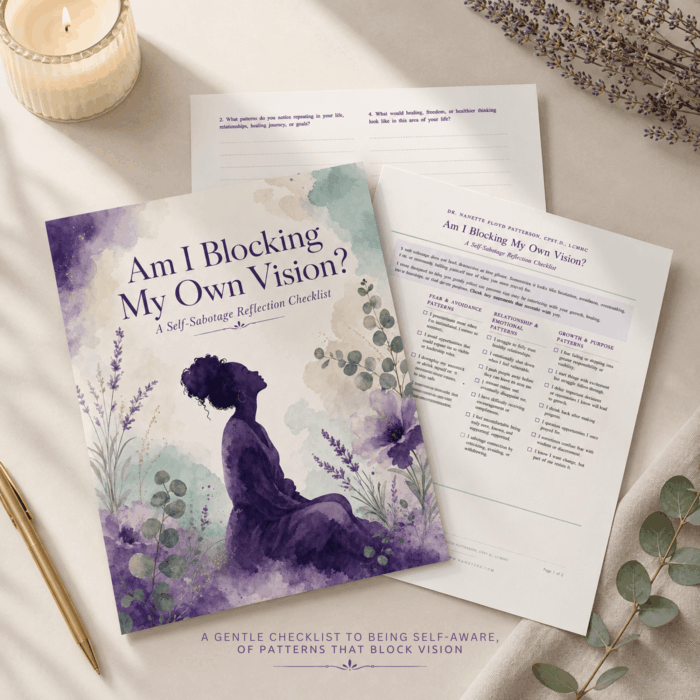
Am I Blocking My Own Vision?
A gentle reflection resource designed to help you identify subtle patterns of self sabotage, distorted thinking, fear-based hesitation, and internal beliefs that may be interfering with your ability to move forward with clarity and confidence.
Am I Blocking My Own Vision Checklist
Dr. Nanette Floyd Patterson, CPsy.D., LCMHC