
Because not all tiredness is the same, and mislabeling it keeps you stuck
“I’m just tired.”
As a Christian therapist, I hear those words often. Maybe you’ve said them recently. Maybe you find yourself saying them more than you’d like.
It comes out so easily because it feels true. But if you slow down and really sit with it, there is usually more underneath those words than we realize.
Because tired is not just tired.
Some are not just tired…they are re-tired. Tired yesterday. Tired today. Waking up tired. Going to bed tired. Pushing through tired.
And when tired becomes your normal, you stop questioning it. You start adapting to it. You start building your life around it.
But that kind of tired is trying to tell you something.
There is a difference between a mind that will not slow down and a heart that feels drained from carrying too much. There is a difference between a body that has been pushed too far and a soul that feels distant, even while doing all the “right” things.
And when you cannot name the difference, you end up trying to fix the wrong problem.
Why “I’m Tired” Is Not Specific Enough
Many women are functioning in a constant state of depletion while still showing up, still producing, still caring for others.
From the outside, it can look like strength. On the inside, it can feel like running on empty.
So you try what you know to try. You rest a little more. You promise yourself better boundaries. You attempt to reset your routine. Yet something still feels off.
That is because the issue is not always about doing less. Sometimes it is about understanding what kind of tired you are actually experiencing.
“For everything there is a season, and a time for every matter under heaven.”— Ecclesiastes 3:1 (ESV)
God did not design you to live in a constant state of output. He built in cycles of rest, renewal, and restoration. When something feels off, it is often an invitation to pay attention, not push harder.
The 4 Types of Tiredness You May Be Carrying
1. Mental Tiredness
This is the kind of tired that lives in your thoughts.
Your mind keeps going even when your body is ready to rest. You think about everything. You replay conversations. You feel overwhelmed by decisions, responsibilities, and information.
Even when you stop moving, your mind does not. You may find yourself saying, “I know what I need to do. I just can’t seem to think clearly enough to do it.”
2. Emotional Tiredness
This is the tired that comes from giving too much of yourself for too long.
You have been strong. You have shown up. You have carried others, supported others, and made space for everyone else. But somewhere along the way, you were not refilled.
Now you feel drained. Maybe even a little numb. You still care, but it takes more effort than it used to.
You may hear yourself thinking, “I don’t have anything left to give.”
3. Physical Tiredness
This is the tired your body has been trying to tell you about. You wake up tired. You move through the day tired. You go to bed tired. Your body has been pushed, ignored, or placed last for so long that exhaustion has become normal.
And your body is asking for something different. Not more pushing. Not more forcing. But care.
4. Spiritual Tiredness
This one is quiet, but it carries weight. You may still be praying, reading, or showing up spiritually, yet something feels distant. The connection that once felt alive now feels flat. You are doing the things, but you do not feel the same.
You may not say it out loud, but internally it sounds like, “I don’t feel God the way I used to.”
It is a signal that your soul needs attention in a different way.
What Changes When You Name It
When you can clearly identify the type of tiredness you are experiencing, things begin to shift.
You stop guessing. You stop applying solutions that do not match the problem. You begin to understand what you actually need.
Clarity creates movement.
And often, that awareness alone brings a sense of relief because you finally have language for what you have been carrying.
A Gentle Way to Get Clear
If you are not sure what kind of tired you are experiencing right now, I created something to help you slow down and see it clearly.
The What Kind of Tired Are You? assessment walks you through four areas. Mental, emotional, physical, and spiritual. It helps you recognize where your depletion is highest so you can respond with intention instead of frustration .
It is about understanding yourself.
You can take the assessment here
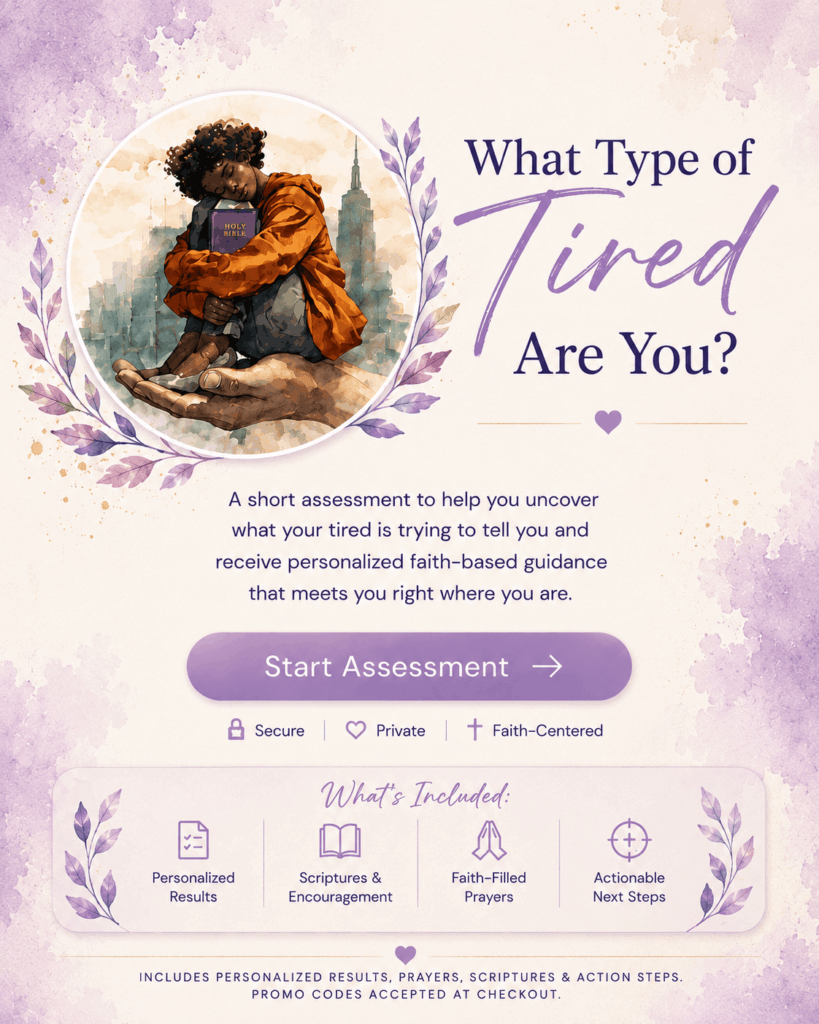
Give yourself a few quiet minutes. Answer honestly. Let it show you what you may not have been able to put into words.
Before You Go
Tiredness is not a weakness.
It is a signal.
Your body is speaking. Your emotions are speaking. Your mind is speaking. Your spirit is speaking.
The question is not whether you are tired.
The question is whether you are willing to listen closely enough to understand what kind of tired you are… and what it is asking for next.





[…] it explains why so many people are tired even when nothing obvious is wrong. They are not just living life, they are carrying what they were […]